
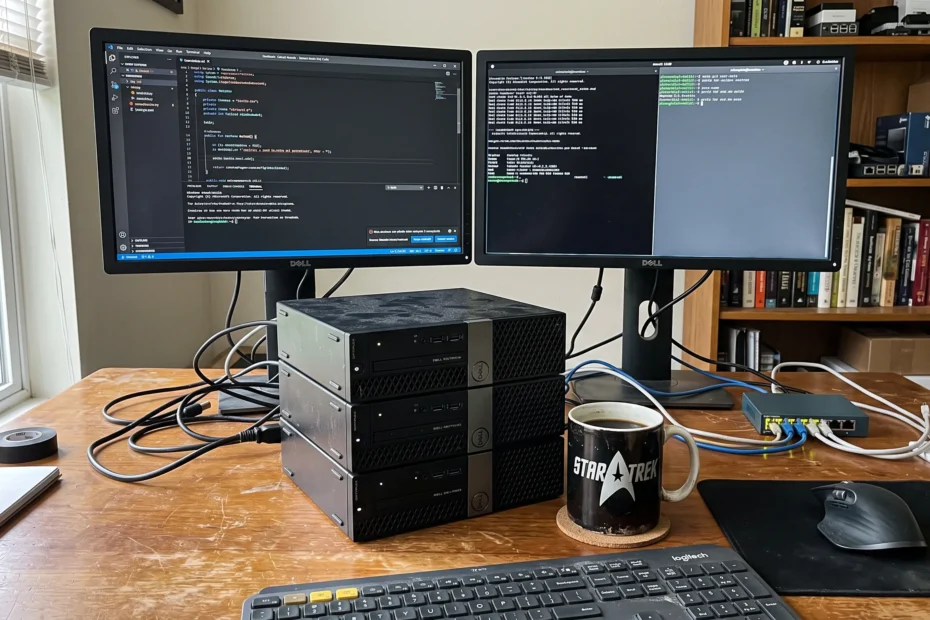
I’ve never been terribly good at letting commercial cloud providers hold onto my life. Between wanting actual ownership of my data, a lingering distrust of corporate telemetry, and the sheer nerdy satisfaction of spinning up a container that just works, my home lab has grown into a bit of a beast. It’s spread across local hardware and a couple of remote VPSes, running Linux and open-source software. There are no corporate trackers, no ads, and certainly no cloud accounts selling habits back to advertisers, values that keep this site running clean as well.
My journey into this rabbit hole started back in 2011 when I first hosted Plex, but for a long time, I was still heavily reliant on paid subscription services like OneDrive, Adobe Creative Cloud, and LastPass. Then came 2022, and the first LastPass data breach made me realise that my trust in big tech was fundamentally flawed. That was the catalyst for looking into alternatives, which led me to discover Vaultwarden via Home Assistant, my first real venture back into self-hosting since those early Plex days, which I picked up in earnest around 2021.
Moving Vaultwarden into its own LXC container and backing it up to my NAS meant I needed to figure out reverse proxies, which naturally sent me back to the research books. That was the definitive “can of worms” moment. Once I realised I could break free from subscriptions, I was hooked. I’ve fired up dozens of services over the years; some stuck and form the core of my stack today, while others were quietly abandoned after a bit of tinkering.
Around the same time, I quickly discovered Proxmox. Having used both Hyper-V and VMware in the past, Proxmox felt refreshingly straightforward to adopt. About 12 months ago, I managed to get my hands on three identical Dell OptiPlex machines, which allowed me to step things up and set up a proper dedicated Proxmox and PBS environment. It is still a million miles away from having a proper server rack, but it works for me and more importantly, it keeps the WAF (Wife Acceptance Factor) high, as moving to loud, full-on rack servers would send domestic harmony downhill rapidly.
If you’re curious about what actually keeps this digital house of cards upright after all that evolution, here is the current inventory of everything currently running in my lab and what it does.
Akkoma
An ActivityPub node for a bit of federated social presence without the corporate cruft, find me here.
AdGuard Home
Network-wide DNS filtering that blocks trackers and ads at the router level, alongside local name resolution for my hosts.
Collabora
In-browser document editing tied directly into Nextcloud, keeping office files away from third-party clouds.
Cumulus MX
Ingests data from my weather station and generates historical graphs because watching barometric pressure shifts is oddly satisfying.
Dockhand
Container management and automation; my preferred alternative to Portainer.
FMD (Find My Device)
A self-hosted device locator that lets me track or remotely wipe a misplaced phone without needing a Google or Samsung account.
Gitea
Lightweight Git hosting for hosting my code repositories local and private. Mine can be found here.
Gotify
A push notification server for alerts from Home Assistant alerts and others, proving far more reliable than built-in Home Assistant defauts.
Home Assistant
The central nervous system for local automation, dashboards, and hardware integrations around the house.
Immich
The main family photo repository, backed up off-site so memories stay safe, private, and entirely under my control.
Jellyfin
Media streaming for video and TV, adopted after migrating away from Plex in favour of proper open-source freedom.
Nginx
This lives on one of my VPSes, my public-facing reverse proxy sitting outside the LAN, forwarding traffic securely back inside over a tunnel.
Navidrome
Subsonic-compatible music streaming server for playing my local audio collection anywhere.
n8n
Low-code automation engine, currently handling email sorting (though it is admittedly a bit of overkill).
Nightscout
Vital health monitoring setup tracking glucose levels for my son, who has Type 1 diabetes.
Nextcloud
The heavy lifter for files, contacts, family calendars, and recipes.
OpenWrt
Custom router firmware running on a Raspberry Pi for managing VLANs, firewall rules, and routing.
Paperless-ngx
Scanned document management featuring local OCR and tagging, keeping paperwork searchable without handing PDFs to commercial services, relevant emails get sent here automatically for archiving.
Proxmox Backup Server
Handles deduplicated backups for VMs and containers, mirroring off-site to an S3 bucket for a proper 3-2-1 strategy.
Proxmox Virtual Environment
The hypervisor backbone providing KVM, LXC, snapshots, and high availability across the lab.
Rybbit
Minimalist analytics tool monitoring blog traffic.
RustDesk
Self-hosted alternative to Team Viewer, remote desktop relay for family tech support.
SearxNG + Gluetun
Private meta-search engine, routed through a VPN when I want to query the web without leaving a trail.
Speedtest Tracker
Logs historical ISP performance so I can keep receipts when the broadband drops.
Traccar
Dedicated GPS tracking server that feeds precise location data into Home Assistant for presence-based automations.
Uptime Kuma
External uptime monitor running on a VPS so I get alerted immediately if the local LAN goes offline.
UrBackup
Backs up physical workstations that aren’t covered by PBS, sending its final archives straight to PBS for safe keeping.
Vaultwarden
Bitwarden-compatible password manager keeping credentials locked down locally.
Wallos
Personal finance and subscription tracker.
WYL (WatchYourLAN)
Local device discovery and history for keeping an eye on network anomalies and stray DHCP leases.
WireGuard
A persistent tunnel linking the VPSes and the LAN, allowing the public Nginx front door to sit safely outside while routing traffic back in.
Yamtrack
Personal tracker for television shows and movies.
People often ask how I manage to keep all this spinning without losing my sanity. The secret isn’t magic; it’s stubbornness, layered backups, and strict network segmentation. Services live across isolated VLANs, containers, and virtual machines, with public endpoints safely quarantined on remote VPSes behind encrypted tunnels. Backups are chained, Proxmox Backup Server, off-site S3 buckets, and UrBackup working together so I can recover from a catastrophic failure with minimal swearing. It’s messy, it’s entirely self-hosted, and it keeps my data right where it belongs: out of reach.