
Linux 7.2 officially slams the door on x86 processors that lack a Time Stamp Counter. We are finally shedding legacy fallback timing code that is genuinely older than some of the fresh-faced nerds currently trying to untangle enterprise cloud monoliths.
If you just felt an urge to hyperventilate into an anti-static bag while staring at your terminal, take a breather. As someone who spends far too much time tinkering away in a quiet room on a Tuesday afternoon when there’s plenty of daylight left, I feel oddly compelled to explain why this is actually glorious housekeeping.
What Even Is a TSC, Anyway?
The Time Stamp Counter is basically a 64-bit register baked right into x86 chips that just ticks away counting clock cycles. It’s been standard issue since the Intel Pentium dropped in 1993, back when everyone was losing their collective minds over CGI dinosaurs in cinemas and rewinding VHS tapes before returning them to the video store.
Honestly, looking at how long the open-source ecosystem clings to ancient silicon out of sheer stubborn refusal to let go is staggering. Linux didn’t even drop support for the original 1985 Intel 386 until kernel 3.8 rolled out in 2013. Linux spent over two decades supporting a processor that was already a museum piece when dial-up modems were screeching away in hallways, purely so someone’s eccentric uncle could run a mail server off a literal brick in a garden shed.
By the time you reach version 7.2 making CONFIG_X86_TSC strictly unconditional, we’re only just trimming away fallback code for processors that missed the memo about the new millennium.
Clean, Pragmatic Engineering
Why does any of this matter to you and your humble hardware stack? Relying on the TSC gives the kernel blistering-fast, high-resolution timing. Falling back to wheezing motherboard alternatives like the ACPI PM timer is roughly equivalent to fetching water with a bucket when you have indoor plumbing.
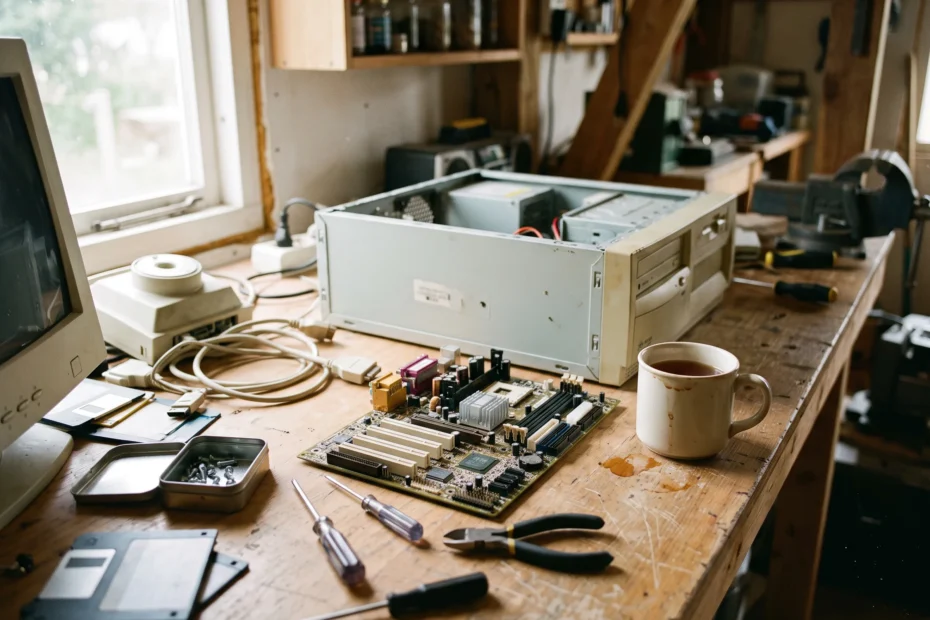
It’s just proper, sensible engineering. You finally empty out the junk drawer, bin those tangled SCART cables and floppy disks you haven’t touched since the nineties, and get on with your afternoon.
A Few Other Bits While We’re Tidying Up
Naturally, when you’re clearing out the workshop, a few other things get tidied up in the process. While the TSC change is undoubtedly the main event, 7.2 quietly smuggled in some neat tricks worth noting while you potter about with your containers:
- Cache-Aware Scheduling: The scheduler is finally smart enough to co-locate threads sharing data within the exact same Last Level Cache domain, stopping your hardware from pointlessly bouncing instructions around like a pinball.
- Fair(er) GPU Scheduling: If you’re hammering your graphics card with local AI experiments or transcoding old media rips, the GPU scheduler now borrows from traditional CPU logic so your desktop doesn’t turn into a stuttering slideshow.
- Tidier Memory Reclaiming: Under-the-hood memory tweaks mean fewer sudden, unceremonious out-of-memory crashes when you push your home lab testbench a bit too far.
If you’re running a Proxmox cluster in your hallway cupboard or wrangling a swarm of Docker containers on secondhand enterprise gear during a sensible Saturday afternoon session, none of this is going to brick your setup. Your hardware has supported a TSC since Meatloaf declared he would do anything for love.
At the end of the day, version 7.2 isn’t about arbitrary gatekeeping; it’s a solid, pragmatic release that lets modern silicon breathe a little easier while you’re peacefully getting things done in broad daylight.
Way to bury the lead. Your perspective on it sucks. You’re down from the top look is self centered and dangerous. The world is more than what you can see. Looking foward to people around the world dumping more e-waste and getting poorer.
Comparing dropping timing fallbacks for 1990s silicon to actual e-waste is a bit rich when Microsoft managed to instantly declare millions of perfectly functional, four-year-old PCs obsolete overnight over an arbitrary TPM chip.
Besides, if you genuinely want to run ancient hardware, this update forces nothing into landfill, you simply stick to an LTS kernel instead of dragging thirty years of dead code through every modern mainline release.
Only reasonable. We’re talking about support for CPUs over 30 years old in mainline kernels.