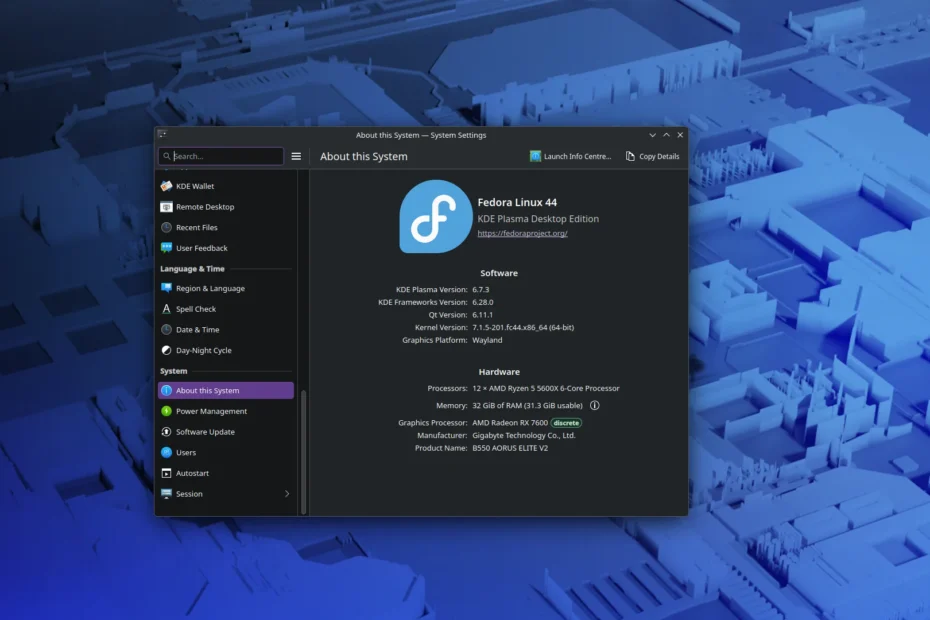
I’ve been stuck in the Windows ecosystem since version 3.1. Think about the legacy there. You build up a certain kind of muscle memory over three decades that’s hard to scrub away. For the longest time, Linux was just a tool in my bag, a server I’d ssh into or a rescue disk for a drive that stopped spinning. But that changed just over two years ago. I finally pulled the plug, went full-time on Linux, and haven’t looked back.
But I’m not going to pretend it’s been a straight line.
If you’ve been here, you know the cycle. Distro-hopping isn’t really a hobby; it’s a symptom. I hit them all. Kubuntu. openSUSE. KDE Neon. Debian. I had a clear target: KDE Plasma. GNOME isn’t bad, it’s just not for me. It feels a bit too alien, too disconnected from how I expect a desktop to behave. I want predictability. I want that stability and the familiar, logical layout that KDE offers. Even with the right desktop, finding the right distribution base felt like chasing a ghost.
Except for Fedora. It had the Btrfs implementation I liked (thank you, openSUSE, for opening my eyes there) and it just stayed out of my way.
Naturally, I left it. Because that’s what we do.
I fell for the CachyOS hype. Arch-based, fast, and the promise of easy AUR access sounded like the ultimate lazy-person’s hack. For a few months, it was genuinely good. I just needed my apps to work, and they did. But the “bleeding edge” maintenance eventually caught up with me. It didn’t take long for the whole experience to start feeling messy.
There’s nothing like right-clicking in Dolphin and watching the window hang to make you realize you’re not as smart as you think you are. Dolphin crashing? Every day? I’m not a masochist. I don’t want to spend my Saturdays digging through Arch Wiki pages to figure out why my file manager is throwing a temper tantrum. I have a Proxmox cluster to maintain and Docker containers to optimize. My desktop shouldn’t be a project, it should be the launchpad.
So, I moved back to Fedora.
The installation experience? It’s night and day from when I started. The Anaconda installer is sharp now. It’s snappy. It doesn’t trip over its own feet. And the installation flow, that specific part where you create the user is handled beautifully within the KDE setup itself after the Fedora base is down. It’s separate from the core install, which makes the whole flow feel polished and logical. Honestly, Microsoft could learn something here. I was up and running in under ten minutes.
Then, there’s the codec situation. People love to complain about it. I get why. But I don’t actually view Fedora’s decision to leave out proprietary codecs as a “bug.” It’s an ethical choice. They want a 100% FOSS system? Fine. Here’s your base. If you want the media players to handle your mp4s, you grab the RPM Fusion repos. It’s a five-minute job. It’s not a hurdle for a real user, it’s just the cost of admission. You do it once, it’s done, you move on.
Total time from bare metal to my daily workflow? Less than an hour.
I’m stopping the hop. Fedora stays on the main rig and the laptop. It hits the sweet spot: modern, stable, and sane. I’m not ditching the other flavors entirely, though. I’m just putting them where they belong. Bazzite is staying on the handheld console because that friction-free gaming feel is exactly what I need on the couch. Debian is doing the heavy lifting on my servers because I want those boxes to be as boring and as predictable as a brick.
For everything else? Fedora wins.
The temptation to break things and start over is always rattling around in the back of my head, probably always will be. But for now? I’d much rather spend my free time in the lab than on the desktop. My partition table is safe, for another six months, anyway.
I use tuxedo os, features kde plasma, and based on debian. Very good distro. Coming from fedora, which constantly broke my nvidia rtx 5090 drivers